

Want to brush up on some Reading Skills over the break , have fun, and earn BEHAVIOR BUCKS? You have come to the right place. Work on Destination Success or FCAT Explorer over the break.
Wednesday, December 16, 2009

Wednesday, December 9, 2009
Community Contributions
Our third grade students in the 4-corners classes sure have caught the spirit of giving. Each day in all four classes, students have been bringing in canned, bagged, and boxed non-perishable food for the needy. They have also been bringing in pet bedding, blankets, cages, and treats for our homeless furry friends at the Humane Society. Here's how it happened: After brainstorming with our students about what we could do to help others and give back to the community, they came up with these two service projects. They wanted to collect as much food as they could for the hungry to brighten up their holidays and fill their stomachs. They also wanted to provide homeless dogs and cats with a more comfortable environment while they are patiently waiting to be adopted. Because of the kindness and empathy of our students, these two projects came to fruition. We are collecting for those less fortunate until this Friday, December 11th. Stay tuned to a future blog which will let you know how much we collected. Our students are so excited to experience the kind and simple act of giving. They realize that when we reach out and give to others, we touch lives, and really can make a difference in this world.
Monday, October 12, 2009
Supplementals for Math and Science

New links are now available on our blog (far left column) to enhance what we are studying in Math and Science!
In the Math section, there are links for building fluency with multiplication facts (the Car Wash Multiplication Game link is especially fun), and the Math U See link offers skill building practice with doubles facts (a current focus for those students who do not know them fluently) and general fact practice with addition, subtraction, and multiplication. Some of our students might also be interested in challenging themselves with the division practice available here now that we have spent recent weeks developing this concept as well.
In the Science section, there is a Science Textbook link so that students can read (or reread) the lesson from our classroom textbook which correlates to what we are currently studying in class. We just started our unit on Matter (Ch. 10), which will be our focus for the next 4 weeks!
We hope you enjoy these awesome new resources to compliment what we are learning in school.
:-) Ms. Phillips
Friday, October 9, 2009
Pronouns "I" and "Me"
Our Language Skill Lesson this week is when to properly use the pronouns "I" and "me". The word "I" is used in the subject (tells who or what) part of a sentence. The word "me" is used in the predicate (after the verb) part of the sentence.
Example:
Shanel and I rode bikes on the beach.
(The pronoun "I" is in the subject of the sentence.
Shanel rode bikes with me on the beach.
(The pronoun "me" is in the predicate part of the sentence and is written after the verb "rode".)
To practice this skill, visit this website: http://jc-schools.net/write/ppt/I-me.ppt
Example:
Shanel and I rode bikes on the beach.
(The pronoun "I" is in the subject of the sentence.
Shanel rode bikes with me on the beach.
(The pronoun "me" is in the predicate part of the sentence and is written after the verb "rode".)
To practice this skill, visit this website: http://jc-schools.net/write/ppt/I-me.ppt
Sunday, October 4, 2009
The 7 Habits of Happy Kids
The 7 Habits of Happy Kids
By Sean Covey
Have you heard your child coming home and telling his or her sibling to be more proactive, begin with the end in mind, or put first things first? Well, there is a good reason for this! We, at 4-corners, are teaching our students powerful principles that will enrich their lives and make them happy by being more successful. These principles are responsibility, vision, respect, teamwork, and balance. Each week, we read a chapter from Sean Covey’s picture book, The 7 Habits of Happy Kids, and we teach a “habit”. We practice this “habit” throughout the week at school and at home. So far we have taught the students the first three habits. The first habit is Be Proactive which means You’re in Charge. The first chapter title is Bored! Bored! Bored! Our students learned that they need to take charge of their own life and stop playing the victim. They learned that they are in charge of their own fun and that they can make it happen just like the character Sammy Squirrel did when he took responsibility for his boredom and found something productive to do. He made a get-well present for his friend, Allie, who was home sick in bed. Sammy learned that he is in charge of his own choices. The second habit we learned is Begin with the End in Mind which means to Have a Plan. This chapter title is Goob and the Bug-Collecting Kit. We learned that if we have a written plan of goals like Goob did, we can work for something that we want to buy like his bug-collecting kit. He not only earned the money ($10.00) by selling lemonade, but he was able to buy his $4.00 bug-collecting kit, a $2.00 mirror for Tagalong Allie’s birthday present, a slice of honey pizza for $1.00, go to the movies for $1.00, take his friend Jumper to the movies for $1.00 (who had previously spent all of his money on junk), and still have $1.00 left to put in his savings bank. Our students have written a school goal that they want to accomplish in 3rd grade. They wrote down their goal, their time frame for meeting their goal, taking their first step, and the steps they need to work towards their goal. We learned that “A goal not written is only a wish.” Our third habit is Put First Things First which means Work First, Then Play. In reading the third chapter, titled Pokey and the Spelling Test, we learned Pokey needed to study a little bit each night to do well on his spelling test, instead of putting off his studying night after night by playing with different friends. He learned to delay gratification and do the hard thing first. Procrastination made him feel awful, but being prepared made him feel great. Our students have been given a survey of what activities they do. They have also been given a time management sheet where they will document their time spent on their daily activities for one whole day. They are learning the meaning of what a wise person once said, “Do what you have to do, so you can do what you want to do.”
*Stay tuned in to more lessons on what your child is learning in The 7 Habits of Happy Kids! Please leave us a comment on your thoughts of these lessons.
By Sean Covey
Have you heard your child coming home and telling his or her sibling to be more proactive, begin with the end in mind, or put first things first? Well, there is a good reason for this! We, at 4-corners, are teaching our students powerful principles that will enrich their lives and make them happy by being more successful. These principles are responsibility, vision, respect, teamwork, and balance. Each week, we read a chapter from Sean Covey’s picture book, The 7 Habits of Happy Kids, and we teach a “habit”. We practice this “habit” throughout the week at school and at home. So far we have taught the students the first three habits. The first habit is Be Proactive which means You’re in Charge. The first chapter title is Bored! Bored! Bored! Our students learned that they need to take charge of their own life and stop playing the victim. They learned that they are in charge of their own fun and that they can make it happen just like the character Sammy Squirrel did when he took responsibility for his boredom and found something productive to do. He made a get-well present for his friend, Allie, who was home sick in bed. Sammy learned that he is in charge of his own choices. The second habit we learned is Begin with the End in Mind which means to Have a Plan. This chapter title is Goob and the Bug-Collecting Kit. We learned that if we have a written plan of goals like Goob did, we can work for something that we want to buy like his bug-collecting kit. He not only earned the money ($10.00) by selling lemonade, but he was able to buy his $4.00 bug-collecting kit, a $2.00 mirror for Tagalong Allie’s birthday present, a slice of honey pizza for $1.00, go to the movies for $1.00, take his friend Jumper to the movies for $1.00 (who had previously spent all of his money on junk), and still have $1.00 left to put in his savings bank. Our students have written a school goal that they want to accomplish in 3rd grade. They wrote down their goal, their time frame for meeting their goal, taking their first step, and the steps they need to work towards their goal. We learned that “A goal not written is only a wish.” Our third habit is Put First Things First which means Work First, Then Play. In reading the third chapter, titled Pokey and the Spelling Test, we learned Pokey needed to study a little bit each night to do well on his spelling test, instead of putting off his studying night after night by playing with different friends. He learned to delay gratification and do the hard thing first. Procrastination made him feel awful, but being prepared made him feel great. Our students have been given a survey of what activities they do. They have also been given a time management sheet where they will document their time spent on their daily activities for one whole day. They are learning the meaning of what a wise person once said, “Do what you have to do, so you can do what you want to do.”
*Stay tuned in to more lessons on what your child is learning in The 7 Habits of Happy Kids! Please leave us a comment on your thoughts of these lessons.
Tuesday, September 29, 2009
Skills Block Practice
I have never seen students so excited as they were today! They were on fire for learning their Spelling Words and their Vocabulary Words. What could have brought about this excitement you are probably wondering? Games, games, and more games! If you want to see for yourself what I am talking about, I challenge you to check out these websites, sit down with your child, and experience the excitement of learning. We thank our very own Zane for demonstrating how the games work. He loves to practice his words by playing these games.
For Spelling practice, go to: Spelling City
For Vocabulary practice, go to: Quizlet
Make sure that you write a comment, and let us know what you thought!
For Spelling practice, go to: Spelling City
For Vocabulary practice, go to: Quizlet
Make sure that you write a comment, and let us know what you thought!
Monday, September 28, 2009
Addition and Subtraction Strategies on the Rise
On a recent math homework assessment, our students showed us some fantastic strategies for finding sums and differences. Here are a few of them:
FINDING SUMS
Solving 27 + 14
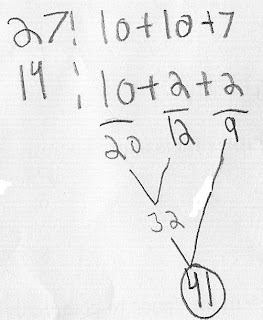

Zane's strategy of Decomposing into Tens and One
Zane decomposed 27 into 10+10+7 and 14 into 10+2+2 and then used "left to right" addition to combine each of the partial sums.
Nathan's strateg y of Compensation for Addition
 y of Compensation for Addition
Nathan subtracted three from the 14 and added three to the 27 to make a "simpler" problem: 30 + 11. By making the first addend a landmark number (30, a multiple of 10), he created an additon problem that could be solved using "mental math".
Camden's model of an Open Number Line for Addition

Camden begins at 27 on her open number line and then makes a "jump" of 10 to get to 37 (mental math problem), and another "jump" of 4 to get to 41.
Franchesca's use of the Traditional Algorithm (Regrouping) for Addition

With this strategy, Franchesca adds from "right to left". 7 + 4 is one "group of ten" and one "one" (11). Leaving the one "one" in the ones place, she then "regroups" the one group of ten to the tens place and combines it with the 2-tens and 1-ten that are already there.
FINDING DIFFERENCES
Solving 74 - 36
Morgen's use of the Open Number Line for Subtraction 
Morgen starts at 74 on her open number line and subtracts 36 from 74 in five stages: 10, 10, 10, 4, and 2. This moves her back 36 on her open number line. Her ending position (38) on the number line represents the answer to this problem: 74 - 36 = 38.
Tekiyah's use of Compensation for Subtraction 

Tekiyah subtracts six from both the minuend and subtrahend to "make the problem simpler". In subtracting the same amount from both parts of the subtraction problem, the difference (answer) is not changed (since the "distance" between the two numbers on a number line remains the same). 68 - 30 is a "mental math" probem, whereas the original problem 74-36 is not as easily solved without pencil and paper methods.
Eder's use of "Straight" Subtraction


Eder first decomposes 74 into 70 + 4 and 36 into 30 + 6. He then subtracts his tens (70 - 30 = 40) and then his ones (4 - 6 = -2). Finally, Eder finds the difference in his two partial differences (40 and -2), which is 38.
Caleb's use of the Traditional Algorithm (Regrouping) for Subtraction

Caleb subtracted from right-to-left. He decomposed 70 into 60 and 10 so that he could subtract 6 ones from 14 ones to get 8. This left him with subtracting 3 tens from 6 tens to get 3 tens. With regrouping, it is important for students to understand that the original number 74 (70 + 4) is still 74 once regrouping takes place (60 + 14 is STILL 74)- this decomposition of a group of ten to make ten ones simply makes subtracting in the ones place easier so that the result (difference) is NOT a negative number (compare back to Eder's strategy where, without regrouping, a negative number results in the ones place).
MATH ROCKS and so do our kids' strategies! Be sure to leave a comment noting your FAVORITE strategy when combining and comparing numbers.
Monday, September 14, 2009
Cover 50
 Today in our Math Workshop we introduced our first "Game", which the kids really loved. This game is called "Cover 50" and reinforces what we have been learning concerning the relationship between factors and multiples. While playing, students had to think about generalizations of multiples, such as even numbers, "factors", only having even multiples (ex. 4- 4, 8, 12, 16, ...). They also had to think about patterns we have studied, such as the ones-place pattern of 5, 0, 5, 0... in the multiples of 5 (5, 10, 15, 20, 25,...) . As students played, they took turns deciding on a "factor" in which they would cover their board with multiples for that factor (their set of cards) with the object of the game being to be the first player to be able to play all ten of their cards on their Cover 50 board. By studying their own set of playing cards against their partner's cards, they developed strategies for calling out the "factor" for their turn that they would have more multiples of than their partner. This game certainly needs to be played more than once and will now be available at a game center in our room for when students find extra time to revisit it.
Subscribe to:
Posts (Atom)